
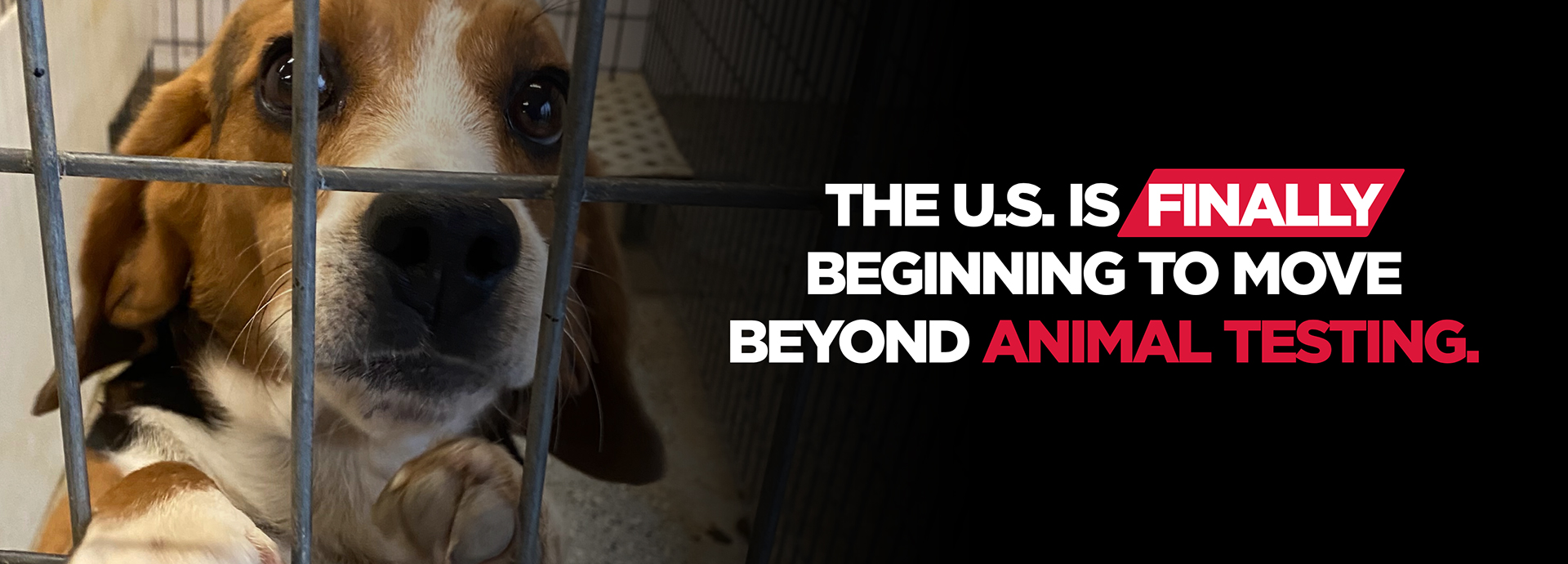
In March 2026, two major federal agencies signaled a clear shift in the United States’ scientific landscape: animal testing is no longer the unquestioned foundation of biomedical research.
The U.S. Food and Drug Administration released new draft guidance, “General Considerations for the Use of New Approach Methodologies (NAMs) in Drug Development,” encouraging drug developers to move away from animal testing and toward modern, human-relevant methods. On the same day, the National Institutes of Health announced a $150 million investment in non-animal research technologies, backing that shift with the resources needed to accelerate it.
Together, these actions mark a meaningful change in how the United States approaches science, medicine, and the use of animals in research.
For decades, animal testing has been treated as a necessary step toward medical progress, despite the fact that nearly 90% of treatments that appear successful in animals ultimately fail in humans. That is not a minor flaw; it is a systemic failure. And its consequences are staggering. Millions of dogs, cats, rabbits, mice, and other animals have endured painful and often fatal experimentation for studies that do not reliably translate to human health: wasting time, resources, and lives in the process.
The FDA’s guidance makes one thing increasingly clear: biomedical research should not rely on a futile, faulty, and cruel system. It explicitly encourages the use of New Approach Methodologies, or NAMs; technologies that allow researchers to study human biology directly rather than through outdated, unreliable animal models. These include organs-on-chips that replicate human organ function using living cells, organoids that model human tissue in three dimensions, and advanced computational systems that can predict how drugs will behave in the human body.
These methods are not only cruelty-free; they are more accurate, more efficient, and more relevant to human health. The science has been moving in this direction for years. What is changing now is the willingness of institutions to catch up.
While the FDA’s draft guidance is not a law, it carries real weight. It defines what the agency is prepared to accept and signals where the field is heading. Companies do not ignore that signal. And while the FDA is not mandating an end to animal testing, it is making something unmistakable: its expectations are shifting.
This moment builds on the FDA Modernization Act 2.0, passed in 2022, which removed the requirement that drugs be tested in animals before human trials. That law made change possible. What we are seeing now is the beginning of that change taking hold.
At the same time, the NIH’s $150 million investment ensures that researchers have the tools to implement these alternatives — not in theory, but in practice.
For years, the justification for animal testing has rested on a single claim: that it is necessary. That claim is now eroding. When better, human-relevant methods exist, and when they are both more ethical and more scientifically valid, continuing to rely on animal testing is no longer defensible.
For Beagle Freedom Project, and for the millions of individuals who have spent years fighting to end animal testing, this moment is a long-overdue acknowledgment of what we have always known to be true: no animal belongs in a lab.
Support BFP’s mission to end animal testing today!